

Contents
Table of Contents
Intro — The Measurement Gap
Modern marketing teams are spoiled when it comes to paid ads.
Open Meta Ads Manager or Google Ads and everything looks precise: cost per click, cost per purchase, ROAS, CAC, LTV projections. Every euro has a trail. Every decision has a number behind it.
Then influencer campaigns enter the picture, and suddenly the clarity disappears.
Traffic comes in waves. Sales spike, but not always immediately. Brand search increases. Comments mention creators. New customers appear… but the dashboard can’t confidently say why. The channel feels impactful, yet strangely hard to prove.
This creates a quiet tension inside many companies.
Founders want clear numbers before increasing budget.
Marketers see the potential and want to scale.
Finance wants proof the channel deserves a bigger slice of spend.
So influencer marketing often ends up stuck in a strange middle ground: clearly valuable, but not fully measurable.
That’s exactly what this guide is about.
We’ll break down how brands turn influencer campaigns into trackable, performance-driven channels, using a practical attribution stack that connects creators to real conversions.
Because influencer marketing becomes truly scalable the moment it becomes measurable.
The Real Problem: Influencer Marketing Lives Across Too Many Touchpoints
The biggest mistake brands make is trying to measure influencer marketing like paid ads.
Paid ads often follow a neat, linear path: click → visit → purchase. Attribution tools love this kind of journey because it’s clean and easy to assign credit.
Influencer marketing doesn’t work like that.
A typical customer journey looks much messier:
A creator posts a TikTok.
Someone watches and saves the video.
Later, they Google the brand.
A few days after, they see a retargeting ad.
Then they finally buy from their laptop.
So… which channel gets the credit? 🤷♂️
Was it TikTok?
Organic search?
Retargeting?
Direct traffic?
The honest answer is: all of them played a role.
This is why influencer conversions feel “invisible” in dashboards. Traditional attribution models are designed for single-click journeys, but influencer marketing operates in a multi-touch world.
And once you accept that reality, the solution becomes clear: you don’t rely on one tracking method.
You build a layered tracking system that captures multiple signals across the customer journey.
The Mindset Shift: From Perfect Attribution to Directional Truth
Before jumping into tools and tactics, there’s a mindset shift every brand needs to make.
Most teams go into influencer marketing asking the wrong question:
“How do we track every single sale perfectly?”
That’s the wrong goal. And it’s the reason many influencer programs stall.
Even paid ads don’t have perfect attribution anymore. Between privacy changes, cookie limitations, and cross-device behavior, perfect tracking simply doesn’t exist.
The real goal is something much more practical:
Directional truth.
You don’t need 100% certainty to scale influencer marketing. You need enough reliable signals to confidently answer questions like:
- Are influencers driving new customers?
- Which creators perform better than others?
- Which campaigns deserve more budget?
- Which content actually converts?
When you combine multiple tracking signals, patterns start to appear. And patterns are what let companies make confident decisions.
This is the moment influencer marketing stops feeling like a gamble and starts behaving like a performance channel.
The 3 Types of Influencer Conversions You Must Track
Most brands make one mistake:
They only look for the obvious sale.
But influencer marketing doesn’t behave like a paid search ad. It influences behavior across time, not just in a single click.
If you want to measure influencer performance properly, you need to track three different layers of conversion.
1) Direct Conversions
This is the easiest to measure.
Someone sees the creator’s content → clicks the link → purchases immediately.
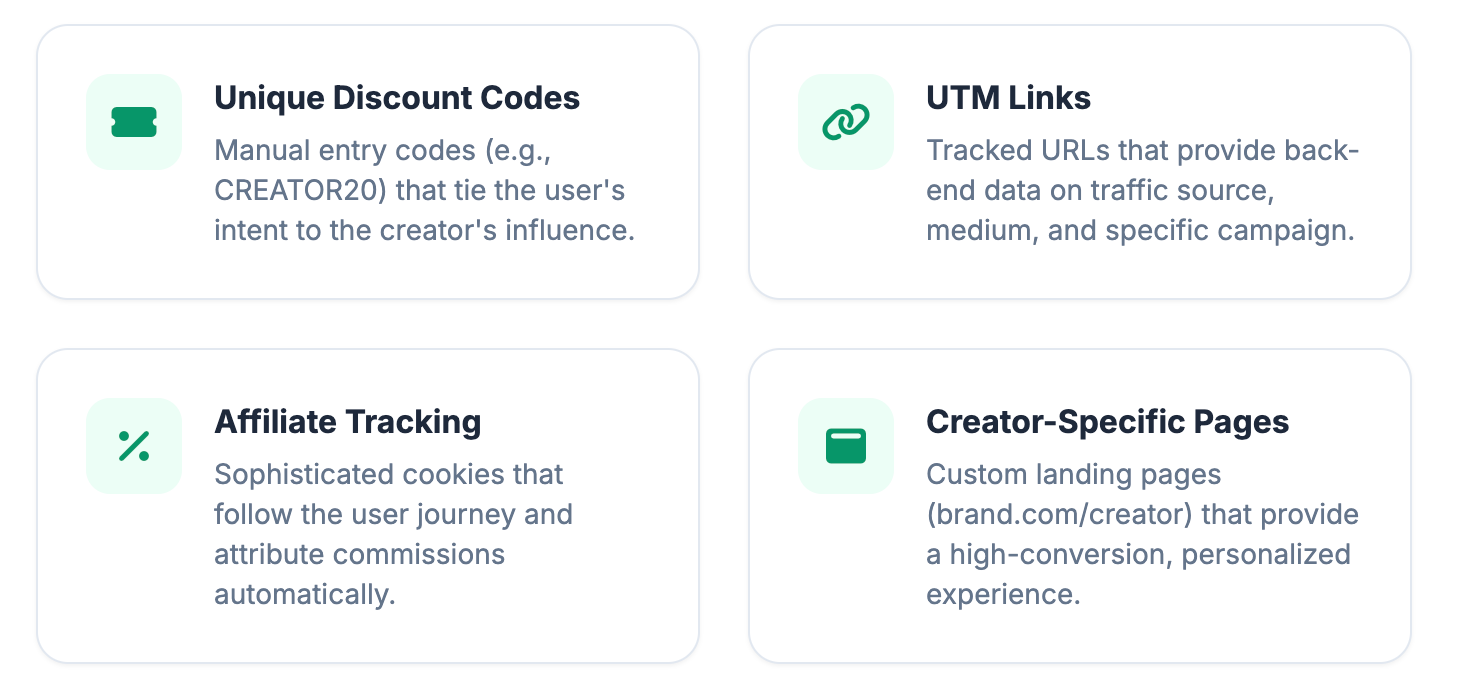
These show up through:
- unique discount codes
- UTM links
- affiliate tracking
- creator-specific landing pages
Direct conversions are clean. Simple. Measurable.
But they are only part of the picture.
2) Assisted Conversions
This is where influencer marketing becomes powerful.
Example:
- Viewer sees a TikTok review
- Saves the video
- Googles your brand two days later
- Clicks a retargeting ad
- Buys
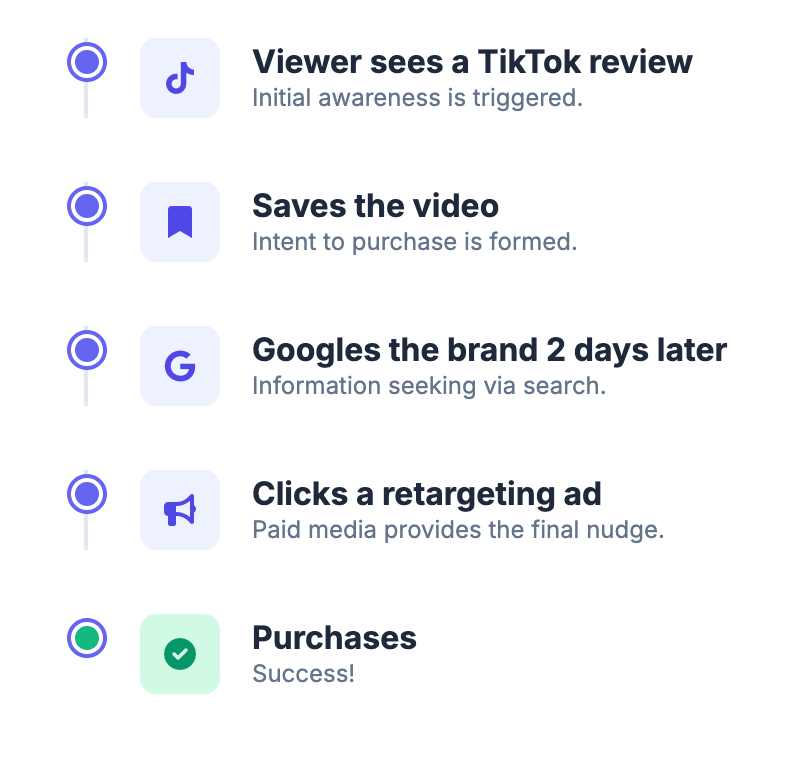
In Google Analytics, the sale might be credited to:
- Paid search
- Retargeting
- Direct traffic
But the creator initiated the journey.
That’s an assisted conversion.
If you ignore this layer, you systematically undervalue influencer campaigns.
3) Invisible Conversions
This is the part most dashboards miss entirely.
Influencer marketing also drives:
- brand search lift
- increased conversion rates across other channels
- stronger social proof
- word-of-mouth momentum
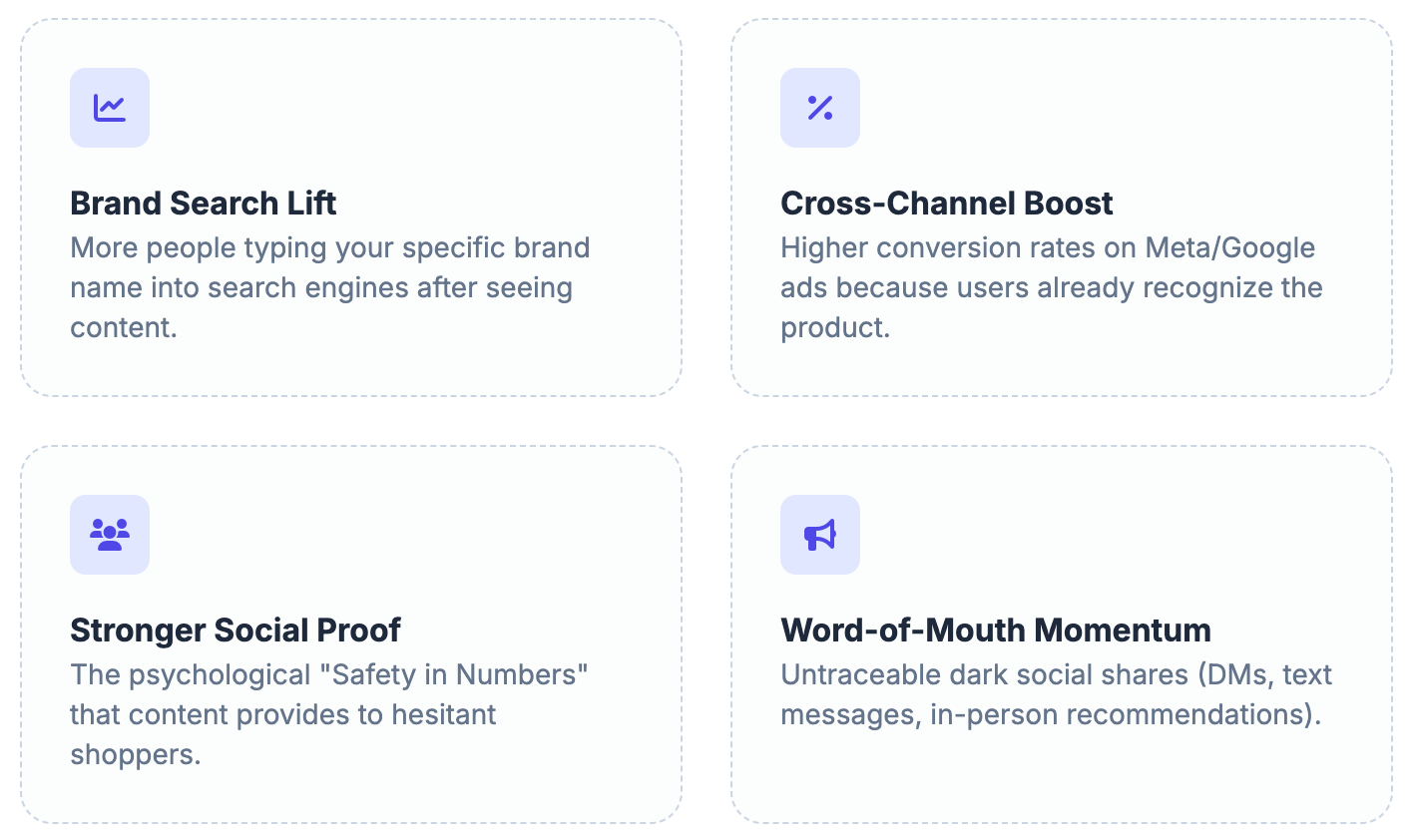
You might see:
- higher branded search volume
- improved Meta ad performance
- better organic conversion rates
And think your ads got better.
But sometimes, what actually improved was trust.
And trust compounds.
The Key Shift
If you only track direct sales, you will almost always underestimate influencer ROI.
Influencer marketing works across:
- attention
- intent
- trust
- timing
Tracking needs to reflect that reality.
The Influencer Attribution Stack (The Big Idea)
Most articles list a bunch of random tracking tactics and call it a day.
But the brands that truly understand influencer performance don’t rely on one method. They build a stack.
Think of attribution like photography: one camera angle rarely tells the full story. But multiple angles create a clear picture.
Influencer tracking works the same way.
Instead of searching for one perfect method, high-performing teams use layered tracking. Each layer captures a different type of signal across the customer journey. When combined, those signals become reliable and decision-ready.
This is the Influencer Attribution Stack.
It has four layers:
Link tracking captures immediate, measurable clicks and traffic.
Code tracking connects creators to purchases, even without clicks.
Pixel tracking reveals assisted conversions and cross-channel impact.
Survey and qualitative tracking uncovers the invisible influence behind brand growth.
Individually, each layer has blind spots. Together, they create clarity.
In the next sections, we’ll break down how each layer works and how brands combine them to turn influencer marketing into a measurable performance channel.
Layer 1: Link Tracking (UTMs & Affiliate Links)
The first layer of the attribution stack is the most familiar — and still one of the most powerful.
Link tracking answers the simplest question:
Who clicked, and what happened next?
This layer combines UTM parameters and creator-specific tracking links into one system that shows exactly how traffic from creators behaves once it reaches your site.
Think of this as your baseline measurement layer. Every influencer campaign should start here.
Why this layer matters
When a creator shares a link in their bio, description, Story, or pinned comment, you create a direct bridge between content and your analytics.
Instead of “we think this creator drove traffic,” you can see:
• how many visitors they sent
• what pages those visitors viewed
• how long they stayed
• whether they purchased
It turns influencer traffic into normal, trackable marketing traffic inside your analytics tools.
The UTM structure brands should use
UTM parameters are simply tags added to URLs so analytics tools understand where visitors come from.
A clean influencer UTM structure usually looks like this:
utm_source → influencer platform (tiktok, instagram, youtube)
utm_medium → influencer / creator
utm_campaign → campaign name
utm_content → creator name
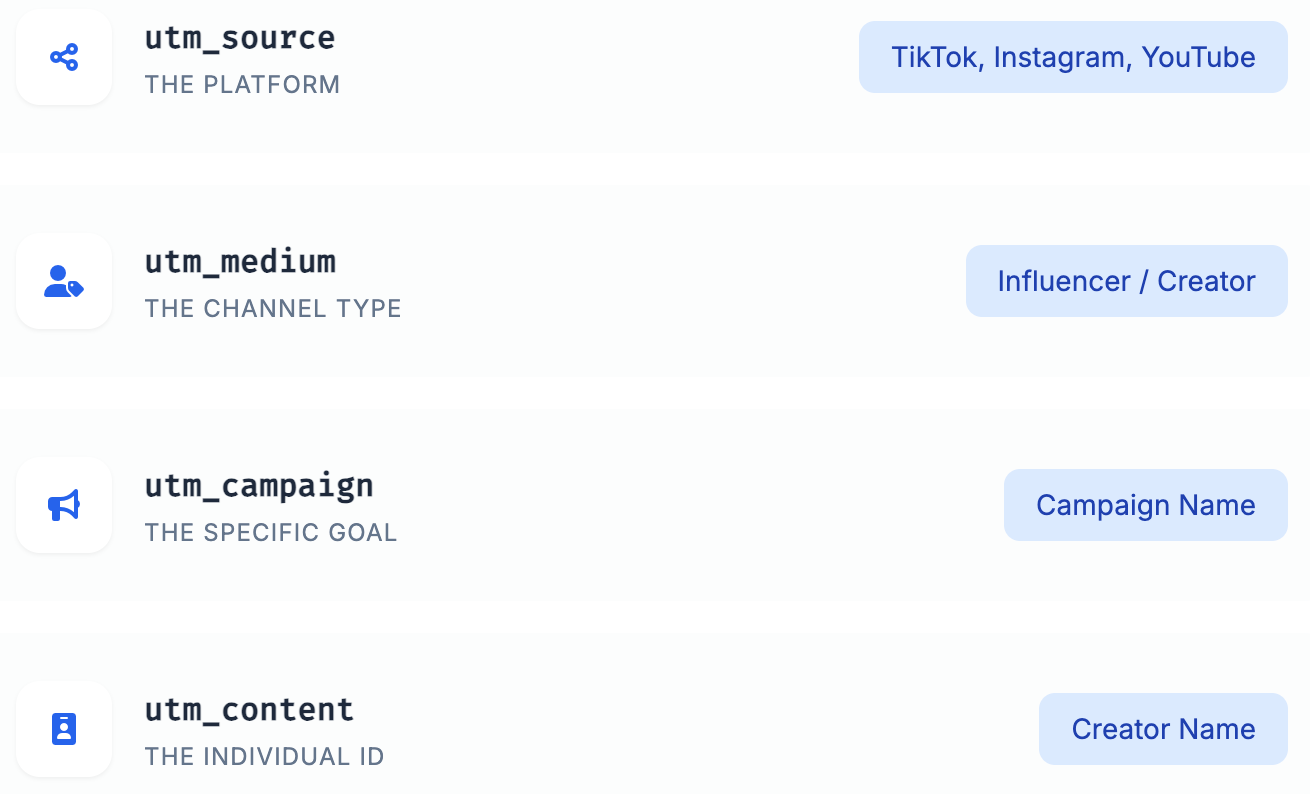
Example:
yourstore.com?utm_source=tiktok&utm_medium=influencer&utm_campaign=spring_launch&utm_content=creatorname
This small detail becomes extremely powerful inside Google Analytics, where you can filter by campaign, platform, or even individual creators.
Suddenly, influencer traffic appears alongside your ads, email, and SEO.
Creator-specific tracking links
Every creator should get their own unique link.
This allows you to compare creators side by side and answer questions like:
Which creator sends the most engaged traffic?
Which one drives the most revenue?
Which platform converts best?
Many brands combine UTMs with affiliate-style links (shortened or branded URLs) to make them easier for creators to share and easier for audiences to trust.
From the outside, it looks simple.
Behind the scenes, it feeds your analytics with clean, segmented data.
What you can see inside Google Analytics
Once links are structured correctly, you unlock real campaign visibility.
You can track:
• sessions and users from each creator
• conversion rate of influencer traffic
• revenue generated by campaign
• top landing pages for influencer visitors
• assisted conversions later in the journey
This is the moment influencer marketing starts behaving like a measurable acquisition channel.
And it’s only the first layer of the stack.
Layer 2: Code Tracking (Discount Codes & Creator Codes)
If link tracking tells you who clicked, code tracking tells you who converted — even without clicking.
This is where many influencer sales actually happen.
Because the reality is simple: a huge percentage of people don’t click links.
They watch, remember the brand, and buy later.
Discount and creator codes exist to capture those delayed, cross-device purchases that links miss.
Why codes are critical
Think about a typical customer journey:
Someone watches a TikTok review on their phone.
Later that evening, they open their laptop and Google the brand.
They purchase directly from the website.
No link was clicked.
Without codes, the sale looks “organic.”
With a creator code, the conversion becomes visible.
This layer captures the memory-driven purchases influencer marketing creates.
How creator codes work
Each creator receives a unique code tied to their campaign.
When customers apply the code at checkout, the sale is attributed to that creator.
This works across:
• devices
• browsers
• apps
• delayed purchases
It’s simple, but incredibly powerful.
And it solves one of influencer marketing’s biggest attribution gaps.
Why codes often outperform links
Codes remove friction.
People remember short words better than URLs.
A viewer might forget a link in seconds, but they remember:
“Use code EMMA10.”
This is especially true on:
• TikTok
• Instagram Reels
• YouTube Shorts
• Podcasts
Anywhere content is fast and mobile-first.
Codes turn awareness into measurable revenue, even when users take their own path to purchase.
Making codes work properly
To make this layer reliable, brands need to treat codes like real tracking infrastructure.
Each code should be:
• unique per creator
• tied to a campaign timeframe
• connected to revenue reporting
• visible in your ecommerce analytics
When implemented well, codes reveal the conversions that link tracking misses.
And when you combine links + codes together, you start seeing the real impact of creator campaigns.
Layer 3: Pixels & Conversion APIs
If links and discount codes show you who clicked, pixels show you what happened after the click.
This is the moment influencer marketing stops being “content” and starts behaving like performance marketing.
When a creator sends traffic to your website, that traffic shouldn’t disappear into “direct” or “organic” in analytics. With proper pixel and server-side tracking, every visit becomes a signal you can measure, retarget, and optimize.
Turning influencer traffic into measurable events
When someone lands on your site from a creator’s link, tracking pixels fire automatically. The Meta Pixel and TikTok Pixel record key actions across the funnel, product views, add-to-cart events, checkout starts, and purchases.
This changes how influencer traffic behaves inside your marketing stack.
Without pixels, the journey often ends at the click. A viewer watches a video, visits your site, and leaves. The data disappears and the campaign looks weaker than it really is.
With pixels installed, that same visitor becomes part of your measurable audience. You can retarget them with ads, track their eventual purchase, and see their revenue appear inside your ad dashboards. Suddenly, influencer campaigns are no longer isolated experiments, they become part of the same ecosystem as paid media.
Why server-side tracking matters now
Modern tracking is messy. Browsers block cookies, iOS limits data sharing, and ad blockers interfere with scripts. This is why many brands now add server-side tracking using tools like Meta Conversion API or TikTok Events API.
Instead of relying only on the browser, purchase data is sent directly from your server to the ad platforms. This makes attribution more reliable and reduces the number of “lost” conversions that never show up in reporting.
For teams trying to prove ROI, this upgrade alone can dramatically change how influencer performance looks on paper.
The importance of attribution windows
Influencer marketing rarely converts in a straight line. Someone might see a TikTok today, click tomorrow, and purchase a week later after seeing retargeting ads or searching the brand again.
If your attribution window is too short, you’ll miss a large portion of these delayed conversions. That’s why performance teams usually analyze longer click windows and compare multiple attribution views.
Once you start looking at conversions over time, the true impact of influencer campaigns becomes much clearer.
Layer 4: Post-Purchase Surveys (The Missing Data)
Even with links, discount codes, and pixels in place, there will always be conversions you can’t fully explain.
This is where the last layer of the attribution stack comes in, and it’s the one many teams skip.
Post-purchase surveys capture the influence that happens outside measurable clicks.
The “dark social” problem
Not every customer clicks the link in a creator’s bio.
In reality, the journey often looks like this:
Someone watches a creator’s video.
They remember the brand name.
Days later, they Google it.
They type the URL directly.
They buy.
In your analytics, this shows up as direct traffic or organic search.
In reality, the creator started the journey.
This invisible influence is often called dark social, conversions that happen because of social content but don’t carry a trackable click.
And in influencer marketing, dark social is huge.
The simplest question that unlocks missing data
This is why many DTC brands add one simple question to the checkout or post-purchase flow:
“How did you first hear about us?”
It sounds basic, but the insights are powerful.
Customers will often answer with things analytics can’t capture:
- “Saw you on TikTok”
- “A creator recommended you”
- “Instagram reel”
- “YouTube review”
Suddenly, the invisible impact becomes visible.
Why high-growth brands rely on this
Fast-growing DTC companies don’t rely on one data source. They combine quantitative data with qualitative insights to see the full picture.
When survey responses start repeatedly mentioning creators, platforms, or campaigns, patterns emerge. You begin to understand which creators drive awareness, which platforms generate discovery, and which campaigns influence buyers long before the purchase happens.
This layer doesn’t replace hard data, it completes it.
Because the most dangerous mistake in influencer marketing is assuming that everything that can’t be tracked didn’t work.
How to Combine the 4 Layers (The Real Setup)
Individually, each layer gives you a partial view.
Together, they turn influencer marketing into a measurable growth channel.
The mistake most brands make is using only one method — usually discount codes — and assuming that’s enough. It’s not. Codes capture some conversions. Links capture others. Pixels reveal assisted impact. Surveys explain the invisible part.
The real setup is hybrid.
Here’s what that looks like in practice.
When a creator is approved for a campaign, they receive:
- a unique tracking link (with UTMs)
- a unique discount or attribution code
- a dedicated landing page (if the campaign is specific)
- a campaign tracked inside your influencer platform
Now every touchpoint is covered.
If someone clicks and buys immediately → link tracking captures it.
If someone remembers the code and buys later → code tracking attributes it.
If someone views the content, doesn’t click, but later converts after seeing retargeting ads → pixel data connects the assisted path.
If someone discovers you through the creator but purchases days later via branded search → post-purchase surveys reveal the influence.
This is how performance brands think.
Not “which one works best?”
But “how do we capture every signal?”
Where this fits operationally
In a structured setup, influencer campaigns shouldn’t live in spreadsheets and DMs.
They should live inside a system where:
- each creator is tied to tracked links and codes
- campaigns are organized by objective
- performance is visible at the creator level
- ROI can be reviewed without guesswork
That’s where platforms like Social Cat naturally fit into the stack.
The goal isn’t just to discover influencers. It’s to run campaigns where attribution, tracking, and performance visibility are built into the workflow, often through dedicated influencer tracking software designed to centralize creator performance data.
Because influencer marketing becomes scalable the moment measurement stops being manual.
And that only happens when all four layers work together.
Common Attribution Mistakes That Distort Influencer ROI
Even when brands implement proper tracking, influencer ROI can still look “off.”
Not because the data is wrong, but because the interpretation is.
The biggest distortion comes from last-click attribution.
Most analytics tools automatically assign 100% of the credit to the final click before purchase. So if someone watches a creator’s TikTok, Googles the brand three days later, clicks a search ad, and buys, paid search gets the credit.
On paper, Google Ads looks like the hero. The influencer looks irrelevant.
But in reality, the creator generated the demand. Search simply captured it.
If you rely only on last-click data, you will consistently undervalue influencer marketing.
Another common mistake is tracking only discount codes. Codes are helpful, they measure intent-driven buyers. But many customers forget the code, purchase on desktop after seeing content on mobile, or simply choose not to use it. If ROI calculations depend entirely on code usage, a large percentage of influence-driven revenue disappears from your reporting.
Then there’s the issue of assisted conversions. Influencers often sit at the top or middle of the funnel. They introduce the brand, build trust, and create credibility. The sale might happen later via email, retargeting, or direct search. If you don’t analyze multi-touch paths inside GA4 or ad platforms, influencer performance will always look weaker than it actually is.
Timing also distorts results. Many teams evaluate campaigns too quickly, sometimes within 48 hours. That works for paid ads, not for influence. Higher-ticket or new-brand purchases often require multiple exposures. Looking at 7- to 14-day windows paints a much more accurate picture.
Finally, there’s the visibility trap. High views don’t automatically equal revenue. But low immediate revenue doesn’t automatically equal failure either. The better question isn’t, “Did this creator generate instant sales?” It’s, “Where did this creator influence the buying journey?”
When brands combine layered tracking with smarter interpretation, influencer marketing stops feeling vague. It becomes measurable, contextual, and scalable, just like any other performance channel.
Turning Influencer Marketing Into a Scalable Performance Channel
Once tracking is layered correctly and attribution is interpreted properly, something important happens: influencer marketing stops being an experiment and starts behaving like a repeatable growth channel.
At this stage, the conversation inside the company changes. Instead of asking “Did this campaign work?” teams start asking “Which creators should we double down on?”
That shift is what turns influencer marketing from a one-off tactic into a system.
Performance teams begin to identify patterns. Certain creators consistently drive traffic spikes. Some audiences convert better with discount codes, while others respond more to retargeting. Specific formats, tutorials, testimonials, unboxings, begin to correlate with stronger assisted conversions. Over time, the data reveals which creators generate awareness, which drive clicks, and which actually close sales.
This is where repetition becomes powerful. Reusing high-performing creators reduces risk, shortens onboarding time, and compounds results. Each collaboration becomes easier to execute because the brand already understands what works, what to expect, and how to brief them. Campaign planning becomes faster, forecasting becomes more accurate, and ROI becomes more predictable.
It also unlocks proper budget allocation. Instead of guessing how much to spend on influencer campaigns, brands can compare creator performance against paid ads, email, and search. Influencers move from the “experimental” bucket into the performance budget, which is where long-term growth really happens.
When influencer marketing becomes measurable, it becomes optimizable. And once it becomes optimizable, it becomes scalable.
Common Tracking Mistakes That Kill Clarity
Even with the right tools available, many brands still struggle to get clean data. Not because tracking is impossible, but because the setup is inconsistent.
One of the most common mistakes is relying on a single tracking method. A brand might use discount codes only and assume that represents total performance. Or they might look only at last-click analytics and ignore assisted conversions completely. This creates blind spots that distort ROI.
Another issue is inconsistent link structure. If UTMs aren’t standardized across creators, campaigns become impossible to compare. One creator might have properly tagged links while another uses a generic landing page. The result is messy reporting and unclear attribution.
Timing also causes confusion. Brands often evaluate performance too early. Influencer campaigns frequently generate delayed conversions, people save content, revisit later, search the brand name, or convert after seeing a retargeting ad. If you judge results within 24–48 hours, you’ll almost always underestimate impact.
There’s also the internal reporting problem. Marketing might understand assisted conversions and multi-touch journeys, but finance teams often look at direct revenue only. Without clear documentation of the tracking stack, influencer marketing can look weaker on paper than it actually is.
And finally, some brands forget to connect tracking back to decision-making. Data isn’t just for reporting. It’s for optimizing. If tracking doesn’t influence which creators you rehire, how briefs are written, or how budgets are allocated, then the system isn’t being fully used.
Clean tracking isn’t about perfection. It’s about consistency. The brands that win with influencer marketing aren’t the ones with the fanciest dashboards, they’re the ones with disciplined measurement habits.
When Influencer Marketing Becomes a Performance Channel
Most brands treat influencer marketing like a creative experiment.
They run campaigns. They collect content. They look at some sales. They move on.
Performance teams think differently. They look for repeatability. They want to know what happens if they put in $10,000 instead of $2,000. They want to forecast outcomes.
The shift happens when influencer marketing stops being content-driven and starts being system-driven.
When you layer link tracking, discount codes, pixels, server-side data and post-purchase surveys together, something changes. The channel becomes measurable across touchpoints. You can see who clicked, who converted later, who searched the brand, who came back through retargeting.
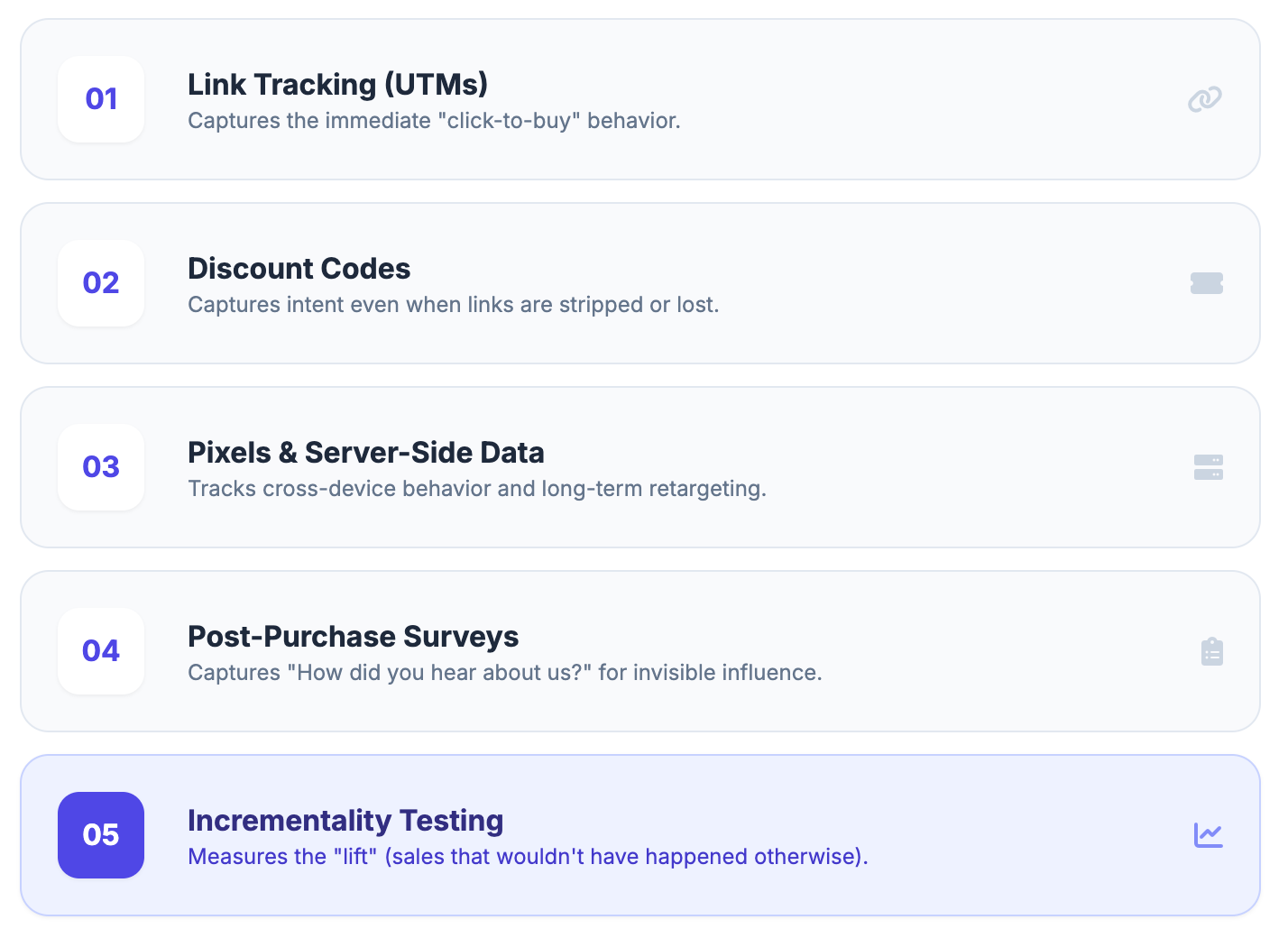
At that point, influencer marketing is no longer “hard to prove.” It becomes comparable to paid media.
And that changes internal conversations.
Instead of:
“Influencers seem to be working…”
The conversation becomes:
“We can model ROI based on tracked cohorts and assisted conversions.”
That’s when budgets increase.
Because finance teams don’t fund creative excitement. They fund predictable systems.
The Maturity Curve
Most brands move through predictable stages.
First, they test creators and hope for direct sales.
Then they notice indirect lift but struggle to explain it.
Then they build structured tracking and start seeing assisted conversions.
Finally, they standardize measurement and can forecast performance based on historical creator data.
That final stage is where influencer marketing becomes an acquisition channel, not just a branding tactic.
It feeds retargeting pools.
It increases branded search.
It improves conversion rates through social proof.
It strengthens paid campaigns.
But none of that is visible without layered tracking.
Conclusion — Influence Is Measurable. But Not in One Click.
The biggest mistake brands make is trying to measure influencer marketing like a search ad.
It doesn’t work that way.
Influencer conversions are multi-touch. They’re emotional. They’re delayed. They’re assisted. They’re often invisible if you only look at last-click attribution.
But when you combine:
structured links,
unique codes,
pixel-based retargeting,
and post-purchase surveys,
you stop guessing.
You start measuring influence in context.
And that’s the real unlock.
Influencer marketing becomes scalable the moment it becomes measurable.
Not because it behaves like paid ads.
But because you finally see the full picture.