Contents
Table of Contents
Your username isn’t just a handle. It’s one of the first signals people use to decide if they should follow you or keep scrolling.
First impression (bio + username combo)
Most people don’t read your bio carefully. They scan your profile fast: profile photo, username, and the first line or two of your bio. In a couple of seconds, they decide if you feel relevant and trustworthy.
A clean, easy-to-read username makes your profile feel “put together.” A messy one (hard spelling, random numbers, too long) creates friction right away, even if your content is good.
Search + discoverability (keywords help)
Instagram search is basically a mini search engine. If your username includes a word that naturally describes what you do (your niche, role, or category), you’re easier to find when people search.
This isn’t about keyword stuffing. It’s just about making it obvious what someone gets when they follow you. The right keyword in the right place can help Instagram (and humans) understand you faster.
The “looks legit” factor (brandability + clarity)
People follow accounts that feel real, consistent, and easy to remember. A good username is simple to say out loud, simple to type, and doesn’t feel spammy. It looks like it belongs to a real person or brand.
Even if your content is strong, a confusing username can make you look “unfinished.” A solid one makes you look established before someone even opens your posts.
Step 1: Decide what you want to be known for
Before you try to “find a cool username,” decide what you want people to associate you with. The best usernames are not the cleverest. They’re the clearest.
If someone lands on your profile for the first time, what’s the one thing you want them to think?
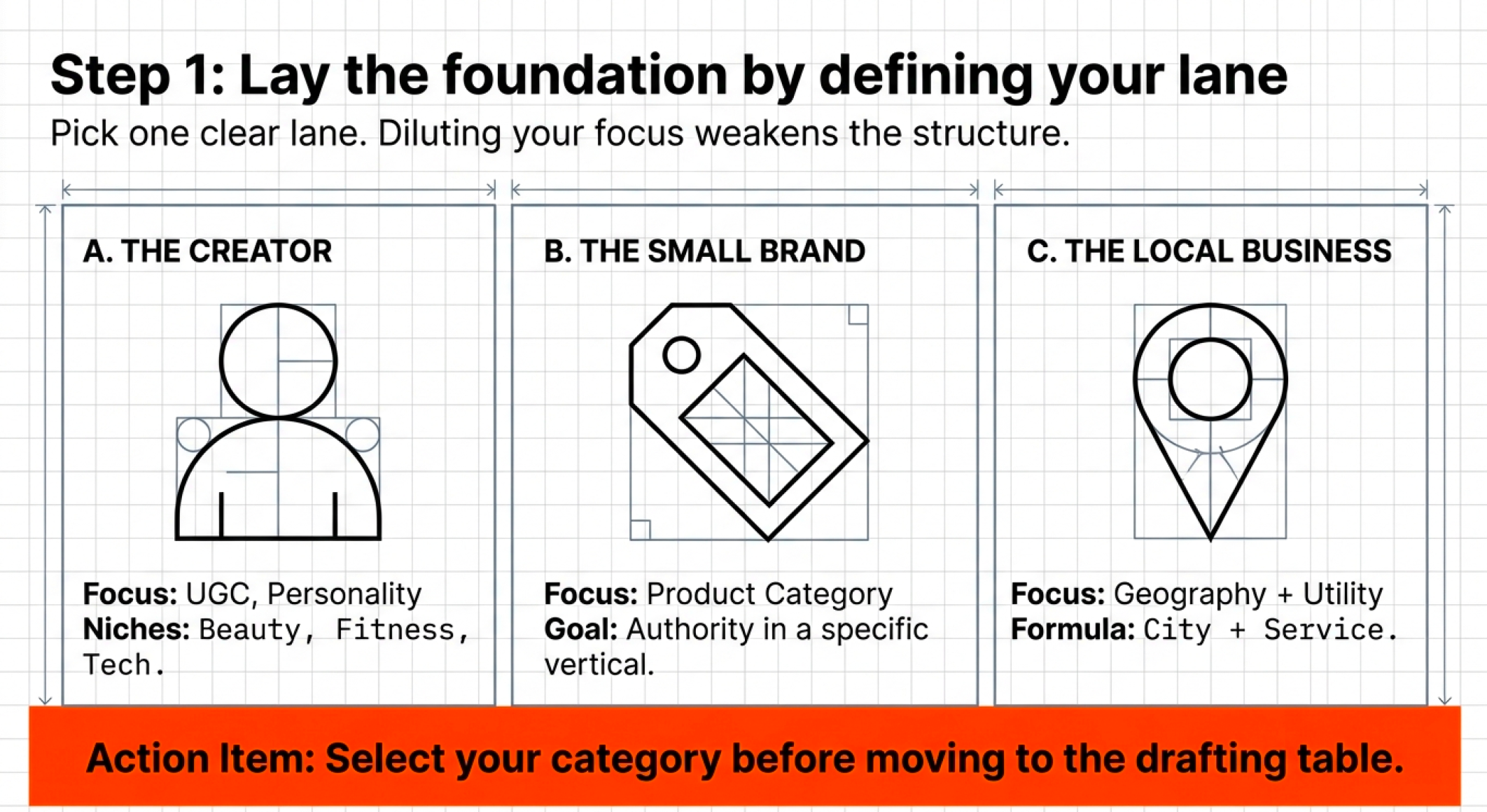
Are you a creator who makes UGC for brands? A fitness person? A photographer? A small business selling something specific? A local service?
Once you pick one lane, naming gets easier because you’re no longer searching the entire universe of ideas. You’re searching inside one box.
Pick one clear lane (creator, niche, or offer)
If you try to include everything you do, your username gets long, confusing, and hard to remember. Instead, choose the one thing you want to be hired/followed for right now. You can always evolve later, but clarity wins at the start.
Use a simple “username formula”
Most strong usernames follow a simple pattern. You don’t need to reinvent the wheel. Here are a few formats that work because they’re instantly understandable:
- Name + niche (good for creators)
- Niche + name (also great for creators)
- Brand word + product (good for small brands)
- City + service (great for local businesses)
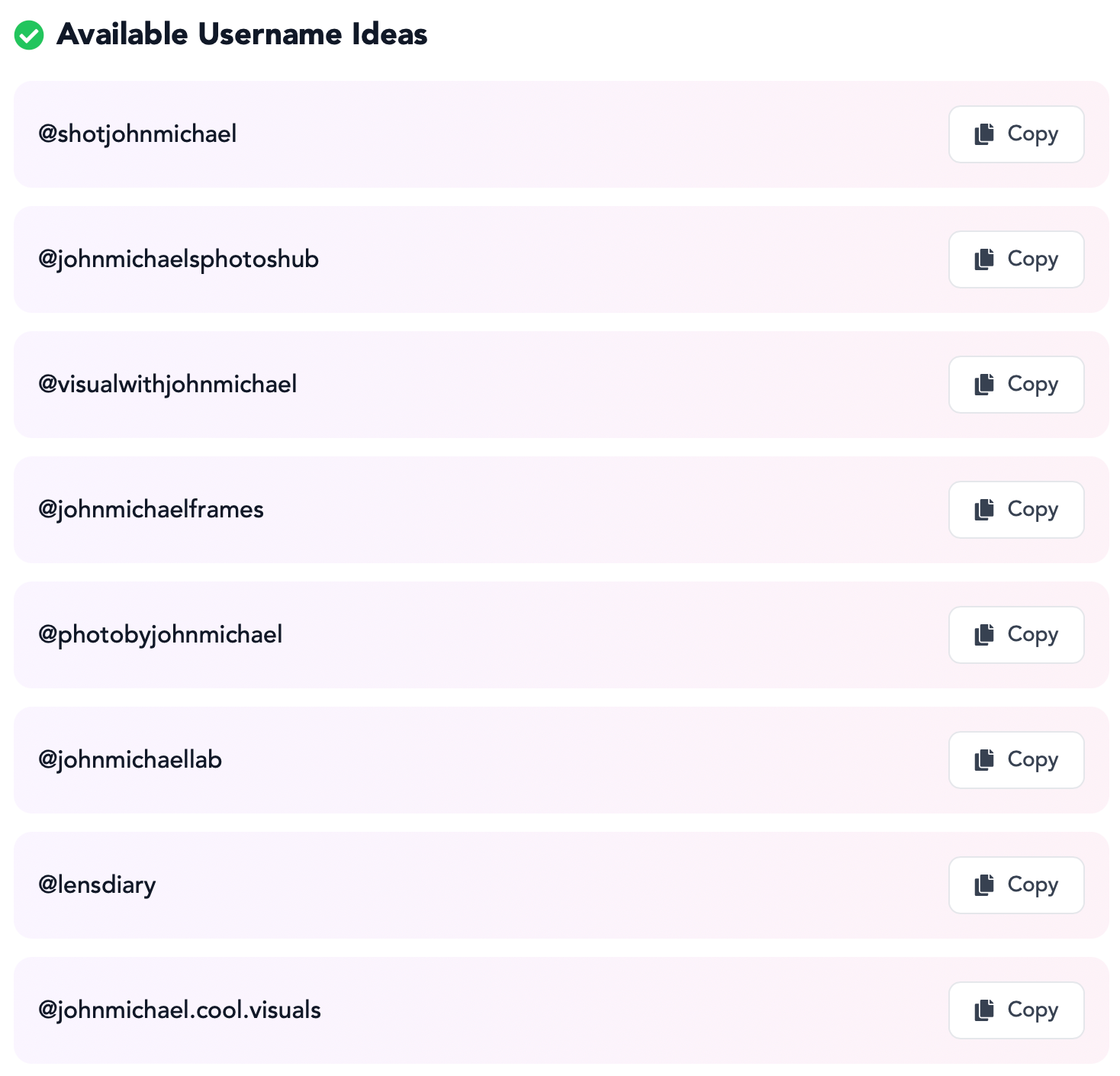
Examples of photography usernames.
The point isn’t the format. The point is: when someone sees it, they immediately get what you’re about.
If you tell me your lane (UGC creator, watch brand, local service, etc.) and the vibe (clean, luxury, funny, minimalist), I’ll generate 20 username directions that fit this step, without going into bullet overload.
Step 2: Make it easy to read, say, and remember
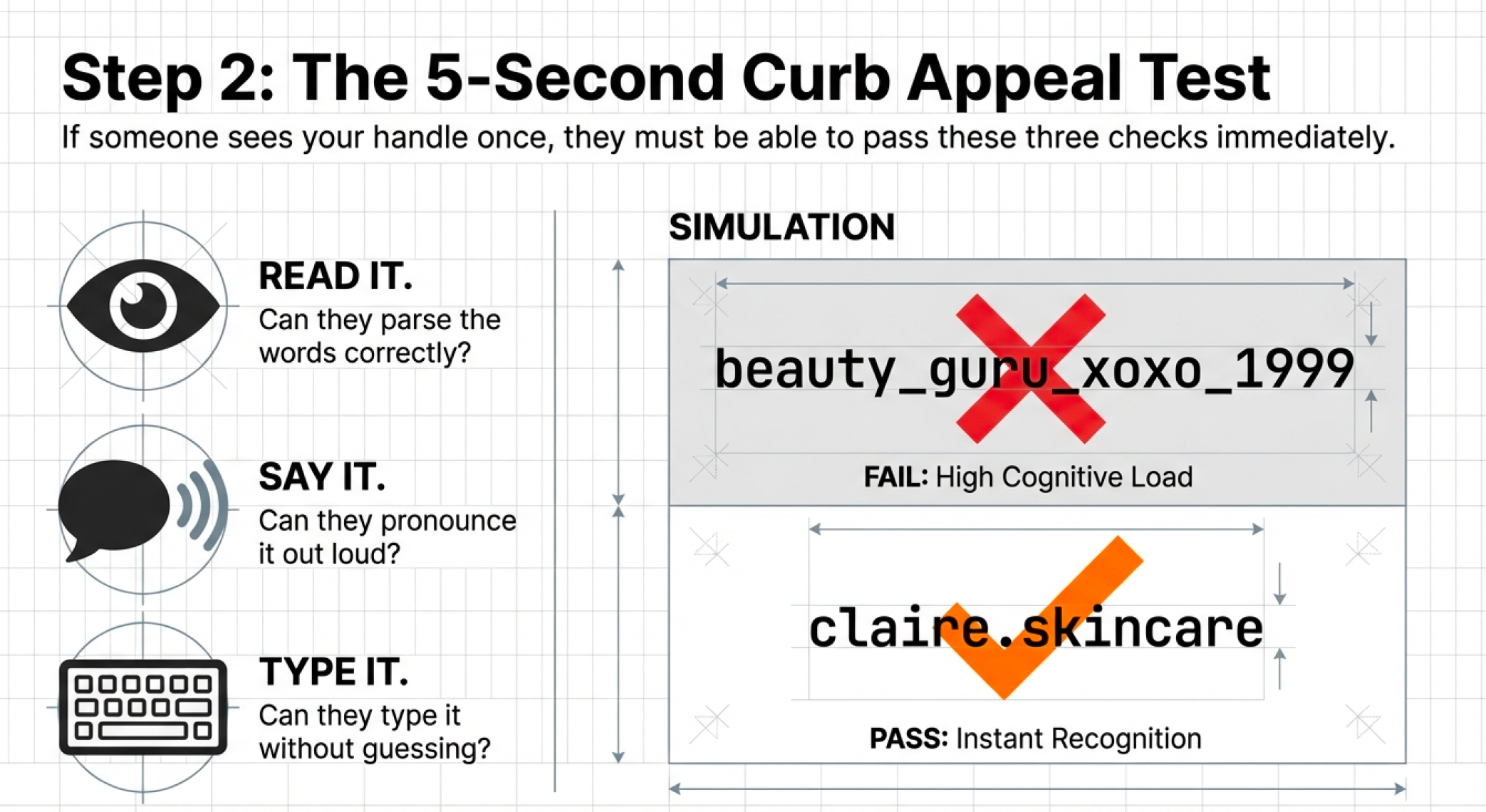
If your username is hard to read, people won’t type it. If it’s hard to say, they won’t recommend it to a friend. If it’s hard to remember, it won’t stick, even if they liked your content.
This step is basically about removing friction.
The “5-second test”
Look at your username as if you’ve never seen it before. In five seconds, can you read it correctly and understand what it is? If someone hears it once, could they type it without asking you to repeat it?
If the answer is “maybe,” it’s usually a no.
Keep it clean (without over-optimizing)
Short is good, but clarity matters more than being tiny. A username like annaskincare is better than something short but confusing like anskrr.
Also, avoid anything that looks accidental or messy. Too many dots/underscores, weird spelling, or stacked words can make the account feel less “real,” even if you are legit.
Small choices that make a big difference
Try to avoid:
- long strings of numbers (unless they mean something)
- awkward abbreviations that force people to guess
- double letters that look like typos
- usernames that are easy to misread (like “rn” looking like “m”)
A good rule: if people might spell it wrong, they will.
Step 3: Add a keyword (only if it fits naturally)
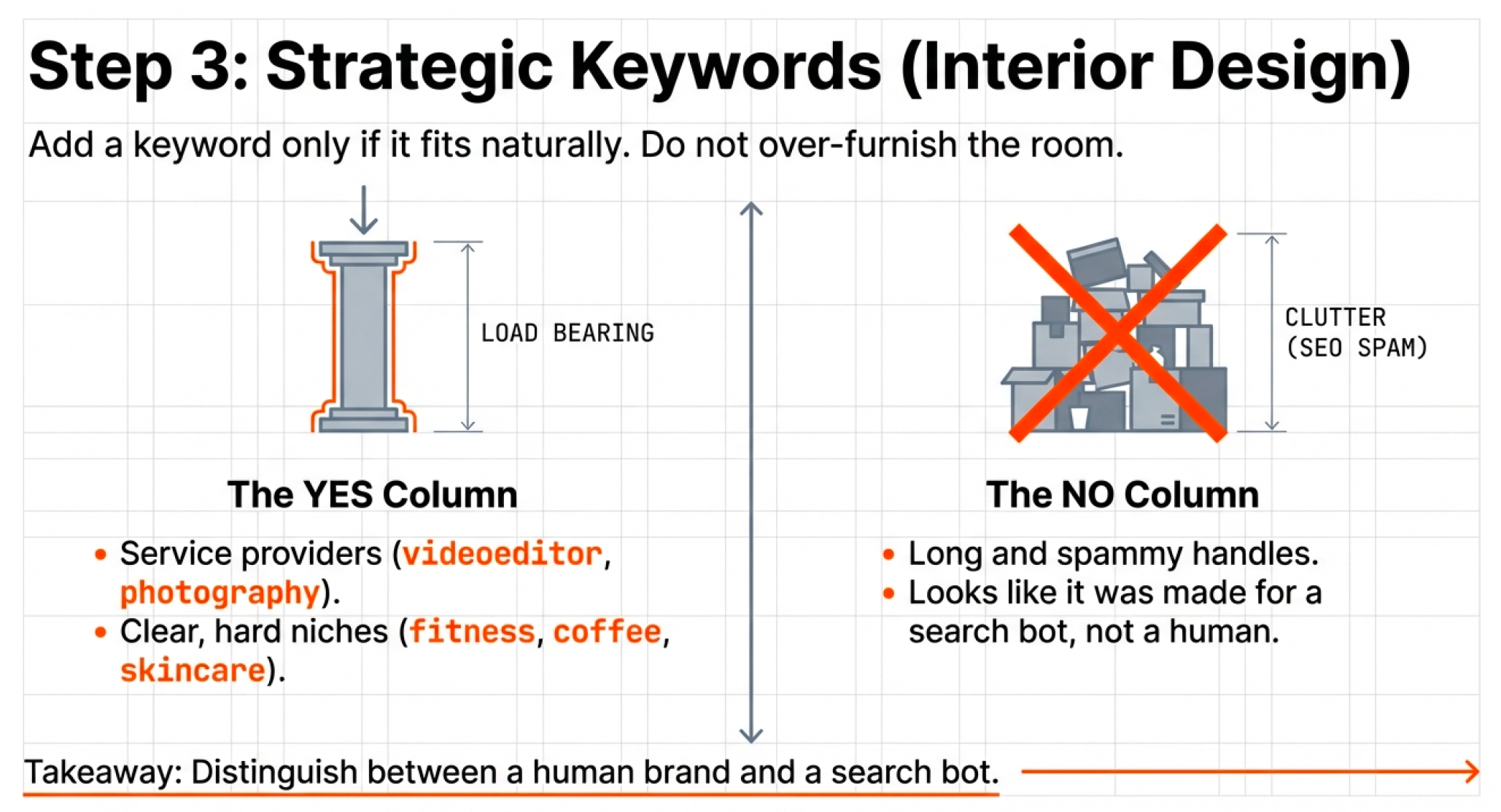
A keyword in your username can help two things: people immediately understand what you do, and you’re more likely to show up when someone searches for that thing on Instagram.
But the keyword has to feel natural. If it looks forced, it can make the account feel spammy, like you made the username for the algorithm instead of for humans.
When a keyword helps
It helps most when you’re clearly tied to a role or service. Think creator roles and local services. Words like “ugc,” “editor,” “studio,” “coach,” “tattoo,” “barber,” “bakes,” “coffee” can instantly set context.
It also helps when your niche is the whole reason someone would follow you. If you’re teaching one thing, reviewing one category, or creating in one niche, a subtle keyword makes you easier to place.
When a keyword hurts
If the keyword turns your username into a sentence, it’s too much. If it creates a long chain of words, it usually looks cheap. And if you’re stacking multiple keywords, it starts to feel like an ad, not a person or brand.
The goal is not “more keywords.” The goal is “more clarity.”
A simple rule
Use at most one keyword, and only if it makes the username easier to understand. If your name already makes it obvious what you do (because your bio + name field handles it), you don’t need to force it into the username.
Step 4: Avoid these common username mistakes
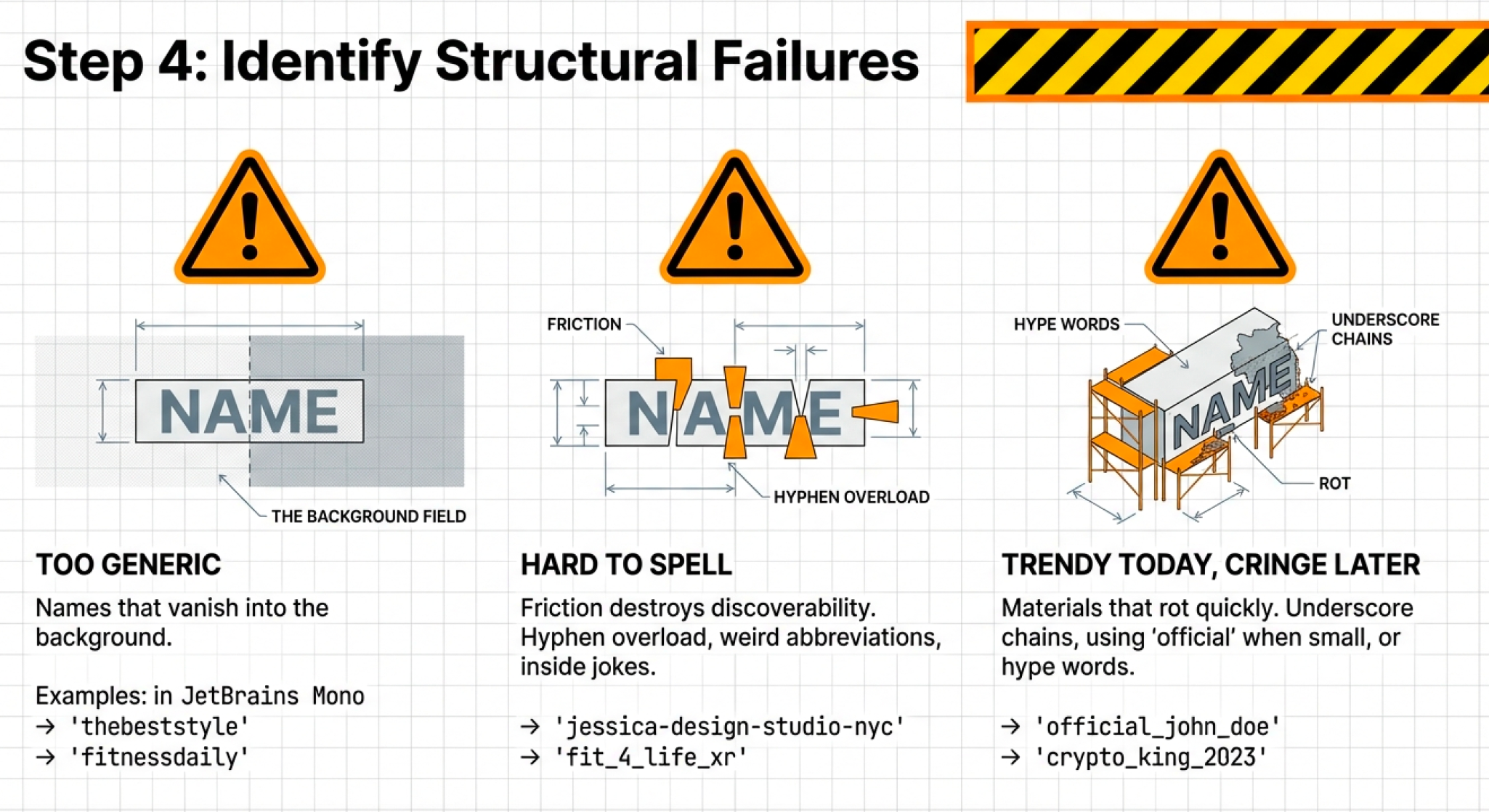
Most “bad” usernames aren’t truly bad. They’re just doing small things that create doubt, confusion, or friction. And on Instagram, friction = fewer follows.
Mistake 1: Too generic to remember
If your username sounds like it could belong to thousands of accounts, it won’t stick. People might like your content, leave, and never find you again. Generic names also make you harder to recommend because there’s nothing distinct to latch onto.
You don’t need something crazy. You just need a small “hook”, a name, a niche signal, or a brandable word that feels like you.
Mistake 2: Hard to spell or easy to mistype
Usernames fail when people can’t confidently type them. That usually happens with weird abbreviations, forced spelling, or too many separators (dots/underscores) that people forget.
If you have to explain how to spell your username, it’s working against you.
Mistake 3: Random numbers that don’t mean anything
Numbers can be fine if they’re part of your brand (like a year, a meaningful number, or a consistent naming system). But most of the time, random numbers look like “the real name was taken,” and that makes the account feel less premium and less intentional.
Mistake 4: Trying to look bigger than you are
Words like “official” can make sense for established brands with impersonators. For most creators and small businesses, it can feel unnecessary and a bit forced.
Same goes for hype-y terms that won’t age well. Your username should still feel good a year from now, not just this month.
Mistake 5: Optimized for the algorithm, not for people
If your username reads like a list of keywords, it can look spammy. People are surprisingly good at sensing when something feels “manufactured.” The best usernames are simple, human, and clear, and that’s exactly what attracts followers anyway.
Step 5: A quick checklist before you commit
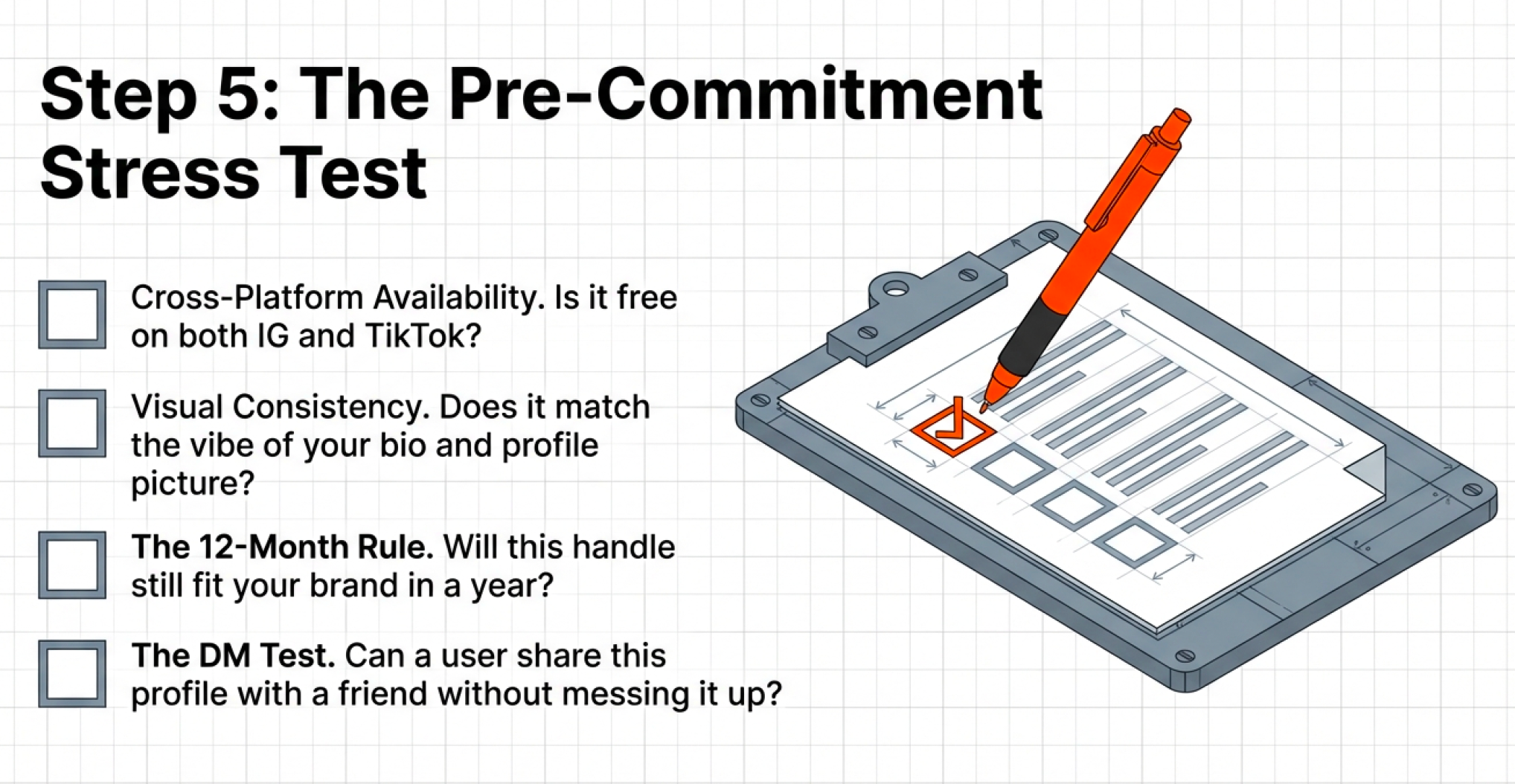
At this point you probably have a few options you like. Now you want to pick the one that won’t cause regret later.
First, imagine seeing the username on a Story mention, a Reel cover, or a DM screenshot. Does it look clean? Does it feel like a real brand or person? Would you be happy to have it on a business card?
Then do the practical checks.
Make sure it’s available on Instagram, and if you care about being consistent across platforms, check TikTok too. Consistency isn’t mandatory, but it helps when people try to find you again.
Also look at your username next to your bio. If your username is already niche-heavy, keep your bio simpler. If your username is very clean and brandable, your bio can carry more of the “what you do” clarity. The two should work together, not repeat each other.
Finally, think one year ahead. If you grow, shift niches slightly, or expand what you do, will this username still make sense? You don’t need to predict your whole future, just avoid names that would feel limiting fast.
The fast way: generate solid options in 30 seconds
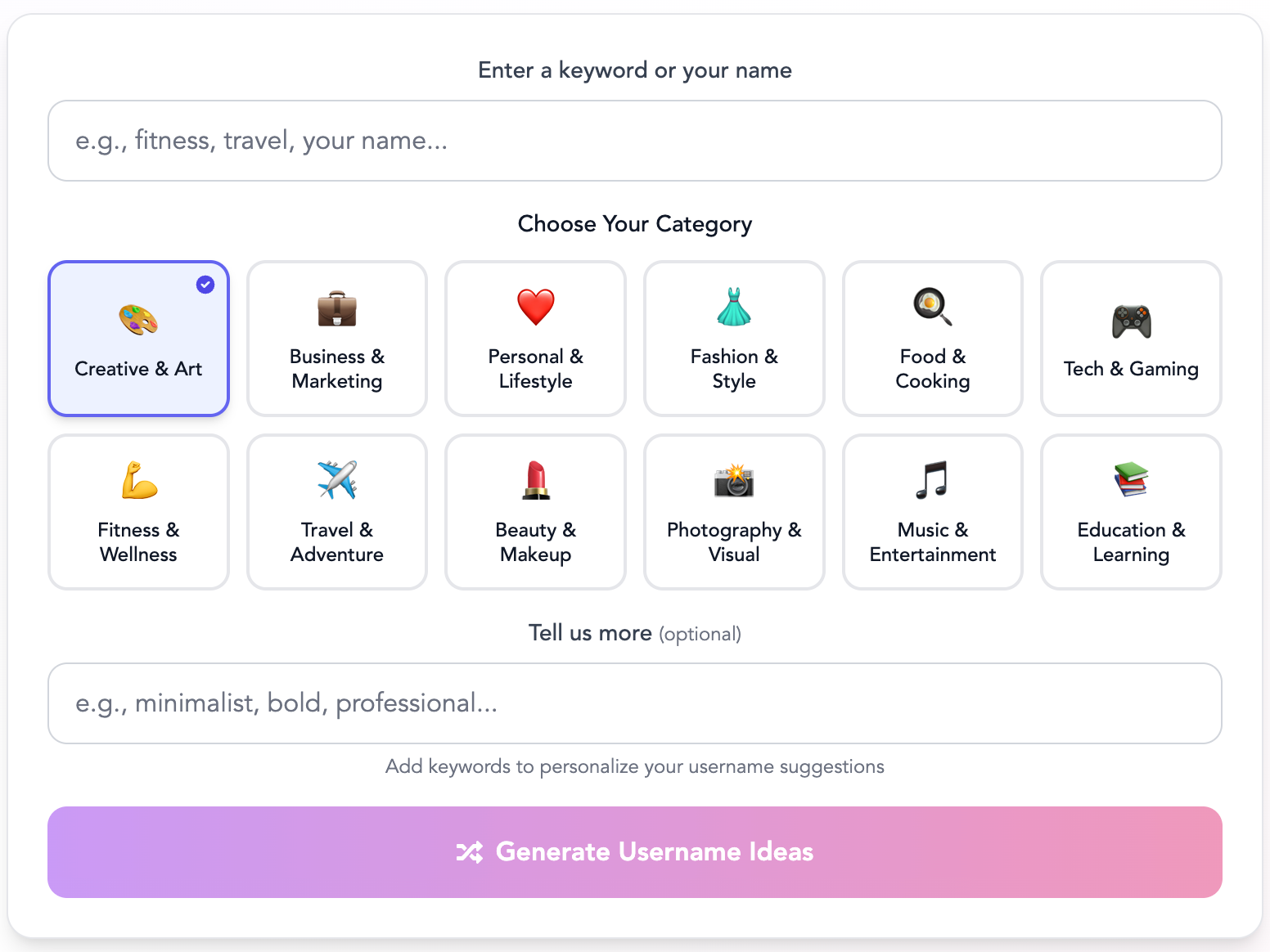
If you’re stuck, don’t brute-force it in your notes app for two hours. Use the Social Cat Instagram Name Generator to get a batch of ideas based on your niche and vibe, then shortlist the best ones and run them through the checklist above.
Wrap-up
A username that attracts followers is usually not the most creative one. It’s the one that’s easiest to understand, easiest to remember, and most consistent with what people see when they land on your profile.
Examples of Instagram usernames that attract followers
You don’t need an original “brand word” that no one has ever used before. You need something that feels clear, intentional, and easy to repeat. Here are a few styles that work because they communicate fast.
Personal brand (creator)
If you’re building around yourself, your name is already a strong anchor. Add a small niche signal only if it helps people understand you immediately.
Examples you can model: a name with a simple separator, or a name plus a short role word like “ugc,” “studio,” or your niche.
Brand page (product)
For brands, clarity beats clever. When someone sees the username, they should be able to guess what you sell or what category you’re in. You can do that with a product word, a category word, or a brandable word that still feels connected to the product.
This is also where “clean and premium” matters most. Short, readable, and consistent usually wins.
Local business
Local names work best when they remove uncertainty. If you’re tied to a place, a city cue can help people instantly know you’re relevant to them.
A simple city + service structure can outperform a “creative” brand name, because people search and follow based on usefulness.
Mini FAQ
Should I use dots or underscores?
Dots usually look cleaner and are easier to remember. Underscores can work too, but avoid stacking them. One separator is enough.
Should my username match my brand name exactly?
If you can, yes. If not, get as close as possible and keep it consistent across platforms. A small modifier is fine as long as it still looks intentional.
What if the name I want is taken?
Don’t jump straight to random numbers. Try a small shift that keeps it readable: a short niche word, a “by + name” structure, or a simple descriptor that fits your lane. If you need ideas, the generator is the quickest way to explore options without making the name look forced.

Written by
Stefan A.
Stefan is a Growth Marketer turned founder with a background in customer acquisition, Influencer Marketing, and early-stage startups. At Social Cat, Stefan drives day-to-day operations and growth, helping small brands connect with the right influencers to scale their reach and impact.