
Contents
Table of Contents
Intro
Paying an influencer isn’t the risky part.
Paying the wrong influencer is.
Because the real cost isn’t just the fee, it’s the time you lose, the content that never ships, the “meh” results you can’t explain, and the headache of chasing someone who looked great on paper.
This guide gives you a simple, repeatable way to vet influencers before you pay, whether you’re doing paid, gifted, or affiliate deals.
You’ll get:
- a quick 2-minute screening flow,
- a full checklist you can score,
- and the red flags that tell you to walk away early.
Let’s make sure the next creator you hire is actually trustworthy.
The 2-Minute Vetting Flow (Use This Before You DM Anyone)
You don’t need a deep audit. You need a fast filter that removes the obvious “no’s” before you waste time.
Step 1 — Quick profile scan (30 seconds)
Open their profile and ask: do I instantly understand what they post about, do they look active right now, and does their content look watchable (basic lighting/audio/framing)? Also check the obvious fit: language and location match where you sell. If this feels off, stop here.
Step 2 — Trust signals scan (60 seconds)
Scroll their last 9–12 posts. You’re looking for consistency: do the posts get a similar level of attention, or is it one spike and a lot of dead content? Open the comments—do people say real, specific things or just generic emojis? Then look for proof they can do what you need: past collabs, product use, demos, explanations, not just pretty shots.
Step 3 — Deal readiness scan (30 seconds)
Finally, check if they seem “campaign-ready.” Do they have a clear contact method? Do they communicate like someone who treats this professionally? Do they show signs they understand deliverables, timelines, and usage rights? If they look unstructured, expect delays and confusion.
Vetting Checklist (Score Each Creator 0–2)
Once someone passes the 2-minute scan, this is the part that saves you money.
Score each category from 0 to 2:
- 0 = risky / unclear
- 1 = acceptable but needs a test
- 2 = strong / confident yes
You don’t need perfection. You need enough “2s” in the areas that matter for your campaign.
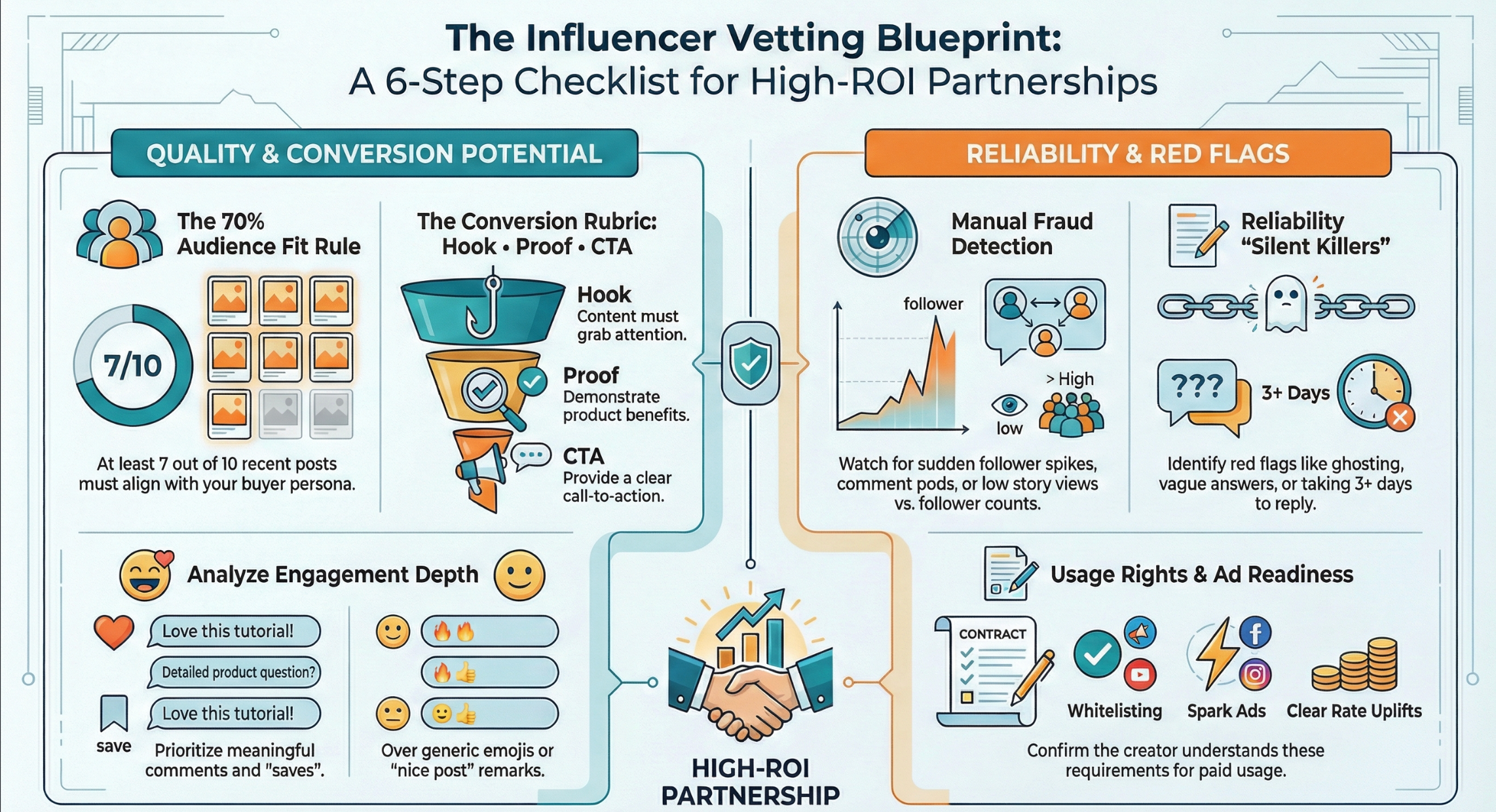
Audience Fit (most important)
This is the one that decides whether you’ll get real results or just “nice content.”
Ask one simple question: Who is their content actually for?
Not who they say it’s for, who shows up in the comments, what language they use, what problems they talk about, what products they naturally feature, and what kind of person would enjoy their posts even if your brand didn’t exist.
A fast check that works: scan their last 10 posts. If at least 7 feel like they could sit next to your product without forcing it, you’re probably looking at a good fit.
Score it:
- 0: audience feels random or clearly wrong for your buyer
- 1: some overlap, but not consistent
- 2: strong match, clear niche, natural overlap with your category
Engagement Quality (not just the rate)
Engagement rate is easy to fake. What’s harder to fake is real attention.
Look for comments that sound human (questions, opinions, inside jokes, people tagging friends with context). Then check consistency: do most posts get a similar “baseline” of interaction, or is it one viral spike and the rest are quiet? If you can see it, saves/shares are a strong sign, those usually mean the content was genuinely useful or entertaining.
Score it:
- 0: generic emoji comments, suspicious patterns, big spikes with dead averages
- 1: mixed, some real engagement, but not consistent
- 2: steady attention + comments that show people actually care
Fake Followers Checks (simple manual scan)
You don’t need fancy tools to spot obvious problems. You’re just looking for “does this account behave like a real community?”
Red flags include sudden follower jumps while engagement stays flat, a weird mismatch between the creator’s location/language and their audience vibe, repetitive commenters showing up on everything, and engagement that looks “manufactured” (same type of comments, same pacing, same few accounts). If they share story views with you during the convo, compare that to their follower count, if it’s extremely low for their size, that’s a common warning sign.
Score it:
- 0: multiple clear red flags, looks inflated
- 1: minor concerns, needs a small test first
- 2: looks natural and consistent
Content Quality & Conversion Ability
A creator can have real followers and still be a bad fit if their content doesn’t sell.
You’re checking whether they can hold attention and communicate benefits simply. Watch 2–3 videos: do they hook you quickly, show proof (demo, use-case, result), and make the next step obvious? Even for aesthetic creators, you want clarity: what’s the point of the content and why should someone care?
Score it:
- 0: nice visuals but unclear message, weak hooks, no proof
- 1: decent content, but inconsistent or needs direction
- 2: strong hooks + clear proof + naturally persuasive
Past Collaborations & Brand Safety
This is where you spot two things early: can they work with brands, and could they create risk for yours. Choosing a good partnership can save you a lot of time and money.
Start simple: have they done collaborations before, and do those posts look natural (not forced, not awkward, not obviously “copy/paste ad”)? If you can find repeats, same brand working with them more than once, that’s a strong reliability signal.
Then do a quick brand safety scan. Scroll their recent content and look for anything that could clash with your values or make your team uncomfortable promoting (controversy-bait, aggressive language, constant negativity, risky jokes, etc.). Also check disclosure habits: do they label ads properly when they do sponsored work? (Not every post will show it, but consistent transparency is a good sign.)
Finally, watch for conflict/competitor issues. If they promoted a direct competitor last week, your campaign is going to feel confusing, and you may end up paying for “category attention” that doesn’t belong to you.
Score it:
- 0: risky content history, messy sponsored posts, competitor conflicts
- 1: some collabs, but limited proof or mild concerns
- 2: clean history, good brand-style content, repeat collabs or strong professionalism
Reliability & Response Speed (the silent killer)
A creator can look perfect on Instagram and still be a nightmare to manage. Reliability is usually visible in the first conversation.
Pay attention to how quickly they reply, but even more to how they reply. Do they answer your questions directly? Do they confirm details (deliverables, timeline, posting window), or do they stay vague? Do they ask anything smart back, like clarifying the product, usage rights, or what success looks like?
You’re basically trying to predict: Will this person deliver without chasing?
A simple benchmark: if it takes days to get a basic answer during the “excited to work together” phase, it usually gets worse after you send product or money.
Score it:
- 0: slow replies, vague answers, dodges details, feels chaotic
- 1: replies eventually, but needs follow-ups to get clarity
- 2: fast + clear + organized, confirms specifics without drama
Usage Rights Readiness (so you don’t get burned later)
This is the part brands forget… until the content performs and then you realize you can’t legally reuse it.
Before you pay, you want to know if the creator understands (and is comfortable with) basic usage rights. That includes whether you can repost the content on your own channels, use it in paid ads, or run it through whitelisting (Spark Ads / dark posting). If they don’t understand any of this, it doesn’t mean they’re “bad”, it just means you’ll have friction, delays, and misunderstandings.
What you’re checking is readiness: can they talk about rights calmly, set boundaries, and give a clear “yes/no + price” instead of getting weird or defensive?
A quick way to ask without sounding legal-heavy:
“If the content performs well, can we also use it on our brand channels and in paid ads for 30 days? If yes, what would you charge for usage/whitelisting?”
If they refuse ads usage, that’s fine, but you should know it before you structure the campaign around performance.
Score it:
- 0: refuses or argues, unclear boundaries, won’t discuss rights
- 1: open but confused, needs explanation and a simple agreement
- 2: understands usage/whitelisting, gives clear terms and pricing
Now, if you ever worked with influencers, you probably know how the vetting process works for Social Cat.
Red Flags That Should Make You Walk Away
Some creators aren’t “bad people.” They’re just bad bets. The goal here isn’t to judge, it’s to avoid paying for predictable problems.
Engagement looks manufactured
If comments are mostly generic (“nice 🔥”), you see the same few accounts on every post, or engagement jumps randomly without a pattern, treat it as a risk. Real communities leave fingerprints: specific reactions, questions, tags with context, inside jokes.
The audience clearly isn’t your buyer
You can’t “creative brief” your way out of a mismatch. If their vibe, language, location, or content theme doesn’t overlap with your customer, you’re likely buying attention that won’t convert.
Their content doesn’t sell anything
Aesthetic is nice, but you still need clarity. If you can’t tell what the creator is trying to communicate, or every video feels slow, unfocused, or “pretty but empty,” you’ll probably get content that looks fine and performs badly.
Vague communication early on
If they can’t answer basic questions (deliverables, timeline, pricing, usage rights) during the first messages, you’ll end up chasing later. Slow replies happen, but repeated vagueness is a pattern.
Weirdness around usage rights
If they get defensive, avoid the topic, or want you to pay for unlimited rights without defining anything, that’s a headache waiting to happen. Rights don’t have to be complicated, they just have to be clear.
If you want, the next section can be Green Flags That Predict Great Results (the positive mirror of this).
Green Flags That Predict Great Results
When a creator is a good fit, you feel it fast, not because they’re “big,” but because the signals line up.
Their audience and your product match naturally
You can imagine your product appearing in their feed without it looking forced. Their niche is clear, the language and location make sense for your market, and the comments look like your kind of customers.
Their engagement shows real attention
Not just likes, real reactions. People ask questions, tag friends with context, and respond to the creator like they know them. Across posts, you see a steady baseline instead of one random spike and silence.
They already know how to present products
Even if they’re small, they can hook quickly, show proof (demo/use-case/result), and make the next step obvious. The content feels like it has a point, not just “here’s a nice video.”
They’ve worked with brands without losing authenticity
You can find past collabs that still feel like them. Bonus points if you see repeat partnerships, that’s one of the cleanest reliability signals.
They communicate like a pro
Clear answers, clear timelines, and no weirdness around details. They either have a media kit or can summarize their offer cleanly in a few lines.
They’re calm and clear about usage rights
They don’t panic when you mention reposting or ads. They either say “yes” with terms, or “no” with boundaries, both are fine. The green flag is clarity.
The Creator Vetting Scorecard (Copy/Paste Template)
Use this as a simple 0–2 scorecard. It keeps decisions objective, especially when a creator “feels” convincing.
Score each category: 0 = risky, 1 = okay but test first, 2 = strong.
1) Audience fit (0–2):
Does their niche, language, location, and audience vibe match your buyer?
2) Engagement quality (0–2):
Do comments and interaction look real and consistent, not manufactured?
3) Fake follower risk (0–2):
Any obvious spikes, weird patterns, or signs of inflated followers?
4) Content quality + persuasion (0–2):
Can they hook fast, show proof, and communicate benefits clearly?
5) Past collabs + brand safety (0–2):
Do past sponsored posts look natural and “safe” for your brand?
6) Reliability + response speed (0–2):
Do they reply clearly and confirm details without chasing?
7) Usage rights readiness (0–2):
Can they discuss reposting/ads/whitelisting calmly with clear terms?
How to interpret the total score
- 0–6: Pass. Too many risks.
- 7–10: Run a low-risk test (gifted/affiliate or 1 small deliverable).
- 11–14: Green light for paid collaboration.
How to “Test Before You Pay” (Low-Risk Trial Options)
Not every creator will be a perfect “yes.” Sometimes they’re promising, but you’re not fully confident. That’s where a small test saves you.
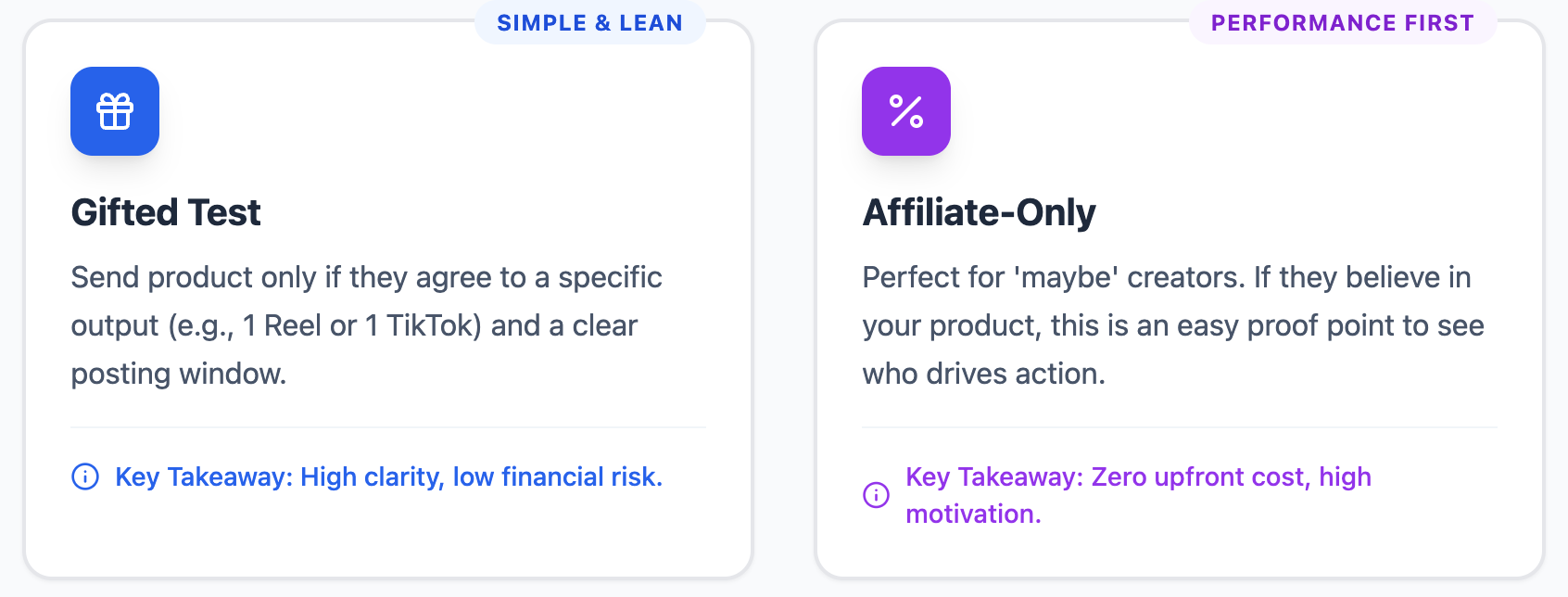
Option 1: Gifted test with one clear deliverable
Send product only if they agree to a specific output (for example: 1 Reel or 1 TikTok) and a posting window. Keep it simple and measurable.
Option 2: Affiliate-only test (great for “maybe” creators)
If they believe in your product, affiliate is an easy proof point. You’ll quickly learn who can drive action without paying upfront.
Option 3: Small paid pilot before a full package
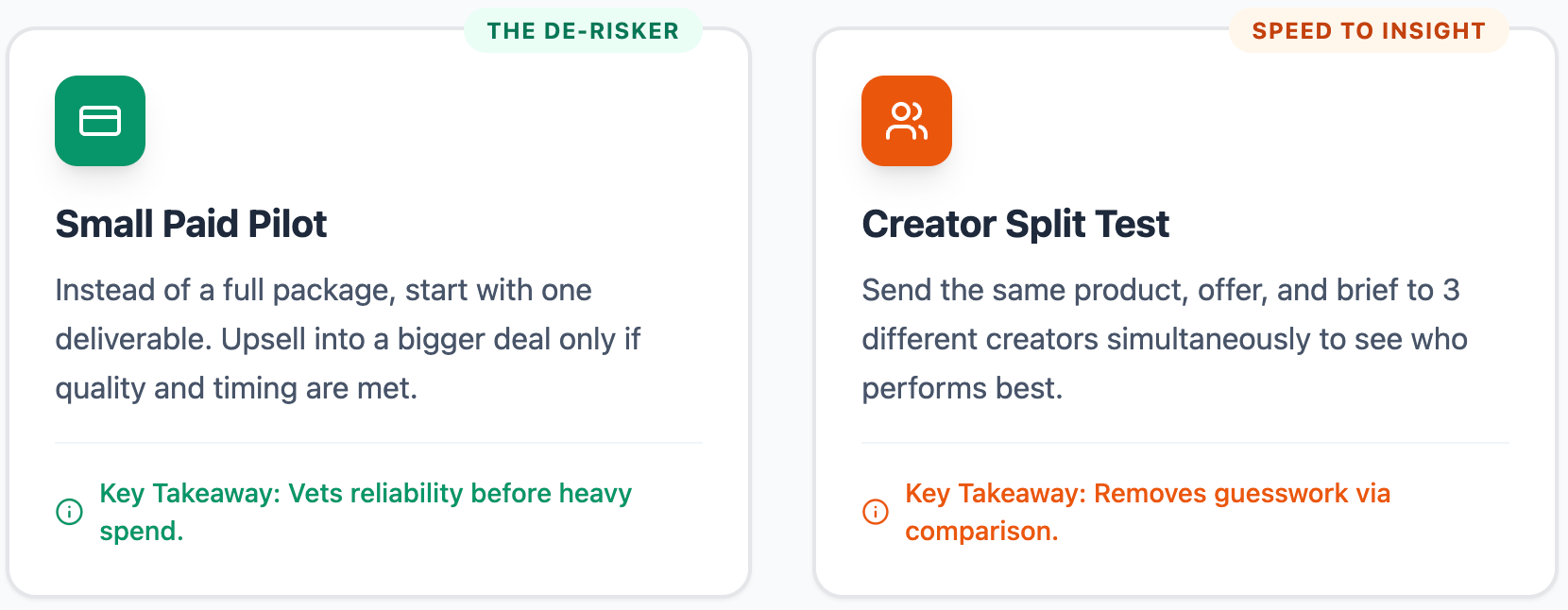
Instead of paying for 3–5 deliverables, start with one. If they deliver on time and the content quality is strong, then upsell into a bigger deal.
Option 4: Split test 3 creators with the same brief
This is one of the fastest ways to learn. Same product, same offer, same brief, different creators. You’ll see who performs and who’s reliable without guessing.
The point isn’t to be cheap. It’s to make your first step reversible.
What to Ask Before You Send Money (Copy/Paste Messages)
This is where most deals go wrong: everyone is excited, but nothing is clearly agreed. These messages keep it clean without sounding corporate.
Quick vetting questions (DM)
You can send this right after they show interest:
Message:
“Hey! Quick questions so we can confirm fit:
- What’s your audience mainly (country + language)?
- What deliverables would you recommend for this product?
- What’s your timeline for filming + posting?
- If the content performs well, are you open to us reposting it and running it as ads for 30 days (usage/whitelisting)? If yes, what’s the fee?”
Short, direct, and it tests professionalism instantly.
Confirmation message (before payment/product)
Use this when you’re ready to lock the deal:
Message:
“Perfect, just to confirm before we move forward:
- Deliverables: [X]
- Posting window: [date range]
- Price: [amount] + payment timing: [before/after]
- Usage rights: [repost only / repost + ads / whitelisting] for [30 days] on [platforms]
- Disclosure: please mark as sponsored/paid partnership
If that looks right, send your email and we’ll share the brief.”
Final Checklist Before You Approve the Deal
Before you send money or ship product, make sure these are clearly agreed (in writing, even if it’s just DMs/email):
You know exactly what you’re getting (deliverables), when you’re getting it (timeline/posting window), and what happens if it’s late. The creator understands disclosure requirements, and you’ve agreed on usage rights (repost, ads, whitelisting) with a clear time window and platforms. Finally, you’ve set a basic tracking method (UTM link, discount code, or a simple “screenshot insights” requirement) so you’re not guessing results afterward.
If any of those are unclear, pause. It’s much cheaper to clarify now than to fix later.
If you’re building creator campaigns consistently, this vetting system works best when it’s paired with two things:
- Outreach templates (so you attract the right creators faster)
- A strong brief (so good creators deliver good content)
And if you want to skip the “random scrolling” part entirely, use Social Cat to find creators that already match your niche, compare options, and run campaigns with less risk.