

Contents
Table of Contents
If you've spent any time running ads or trying to grow a brand online, you've probably seen both terms thrown around constantly: UGC and influencer marketing.
Most brands treat them like they're the same thing. They're not. And that mix-up ends up costing real money, either paying for reach when you needed content, or buying content with no plan to actually use it.
This article breaks down the real difference, how each one works, and when to use which. By the end, you'll know exactly where each fits in your strategy.
What is UGC (User-Generated Content)?
UGC is content created by real people, for a brand, but here's the part most people miss: it's usually never posted on the creator's own profile.
The brand owns it. The brand decides where it lives and how it's used.
That means the creator films a video, sends it over, and you run it as an ad. Their audience never sees it. But if the content is good, it doesn't matter, because it's built to perform in a feed, not to ride on someone's follower count.
You control the brief, the messaging, and the edit. Think of it as content that feels organic but is built with a very clear goal in mind.
What is Influencer Marketing?
Influencer marketing flips that model entirely.
Here, you're not just paying for content, you're paying for access. Access to an audience that already trusts the creator, already engages with what they say, and is more likely to listen to a recommendation than an ad.
The creator posts on their own platform. Their followers see it. And because it comes from someone they actually follow, it lands differently than a brand running its own ads ever could.
You give up some control over the final output, but what you get in return is reach and credibility that's genuinely hard to manufacture. Influencer Marketing Hub tracks benchmarks and platform data across the industry if you want to dig into the numbers.
Not sure where to start? Nano vs micro-influencers is a good first read to figure out which type of creator actually fits your brand.
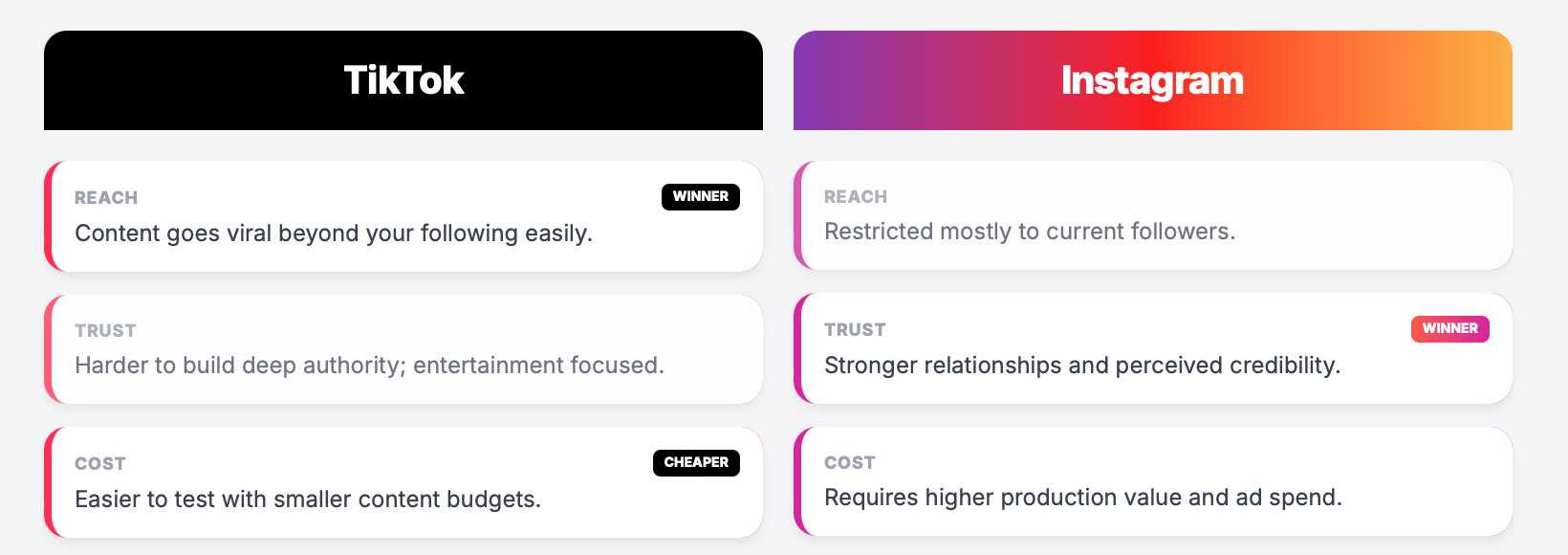
Instagram vs TikTok: Key Differences
When Should You Use UGC?
The short answer: when your goal is performance.
If you're running paid ads on Meta or TikTok and you need a steady stream of content to test, UGC is built for that. It's raw, it's relatable, and it blends into the feed in a way that polished brand creative usually doesn't. Meta's own research has consistently shown that creative is the single biggest variable in ad performance.
It's also the right move when you need volume. Ad fatigue is real. One video won't cut it. UGC creators can produce variations, hooks, and formats consistently without the price tag of a production agency.
And since you're not paying for anyone's audience, you stay in control. The brief is yours. The messaging is yours. You decide what gets used and where. If you need help structuring that, what to include in an influencer brief is worth bookmarking.
If you're thinking "I just need content that converts," UGC is almost always the answer.
When Should You Use Influencer Marketing?
When your goal shifts from performance to visibility, that's where influencer marketing earns its place.
Getting a product in front of a creator's audience feels different from an ad. It feels like a recommendation. That trust transfer is real, and it's something no amount of ad spend can fully replicate on its own. Nielsen's trust research found that recommendations from people consumers know, or feel like they know, consistently outperform traditional advertising for driving purchase intent.
It's especially valuable when you're launching something new, entering a new market, or trying to build the kind of social proof that makes people feel like your brand is already a thing. One creator talking about your product is good. Five creators talking about it at the same time creates momentum. Why nano-influencers convert better than celebrities breaks down exactly why that is, with data.
If you're thinking "I want people to actually know who we are," influencer marketing is where to start, and gifted collabs are often the most practical first step for brands that aren't ready to commit to paid partnerships yet.
The Best Strategy? Use Both
This isn't an either-or decision.
The brands that see the best results don't choose between UGC and influencer marketing, they combine them.
UGC becomes your fuel for ads. It gives you a steady flow of content you can test, optimize, and scale. You control it, you iterate on it, and you use it to drive conversions.
Influencers, on the other hand, give you distribution and credibility. They put your product in front of real audiences and add that layer of trust you can't fake with ads alone.
When you use both together, things start to click. You can work with influencers to create content and build awareness, then reuse that style, or even the same creators, for UGC that you run as ads. Or you can test what works with UGC first, then double down by partnering with influencers who match that angle.
One brings performance. The other brings reach. Together, they create a full funnel, from discovery to trust to conversion. If you want a simple way to know whether any of it is working, how to measure influencer ROI without expensive software is a practical place to start.
Final Thoughts
There's no "better" option here.
UGC and influencer marketing solve different problems. One helps you convert. The other helps you get seen and trusted. The real question isn't which one is better, it's what you're trying to achieve right now.
If your goal is performance, go with UGC. If your goal is awareness and trust, go with influencers. And if you want to build something that actually scales, you'll end up using both.
That's what smart brands do. They don't pick sides, they build systems that combine content and distribution. If you're ready to start with influencer marketing, Social Cat makes it easy to find and work with nano and micro-influencers who are actually a fit for your brand.